







Have you ever wondered how electricity travels through the wires in your home and powers your lights, your television, or charges your phone? All of this has to do with something called electrical voltage, and although it may sound technical, it is actually a simpler concept than it seems.
In this article, we explain exactly what electrical voltage is, what its units of measurement are, and why it is important in our everyday lives.
What is electrical voltage?
Electrical voltage, also known simply as voltage, is the difference in electric potential between two points in a circuit. This potential difference is what drives electrons to move through a conductor, generating an electric current. Put simply, electrical voltage is the "force" that makes electricity move through a circuit.
In more technical terms, voltage is measured in "volts" (which is why it is also referred to as "voltage"). The higher the number of volts, the greater the force pushing electricity through the wires. So, when we talk about electrical voltage, we are talking about the energy that keeps everything running, from your coffee maker in the morning to your computer at work.
The importance of electrical voltage
Electrical voltage is important because it determines how electrical and electronic devices operate. Every appliance we use in our daily lives is designed to work at a specific voltage, and supplying the wrong voltage can cause malfunctions or even permanently damage appliances or devices.
Units of measurement for electrical voltage
The unit used to measure electrical voltage is the volt (V), named after Alessandro Volta, a pioneer in the study of electricity. Volts are used to quantify the difference in electric potential between two points.
Volts (V)
The volt is the standard unit of electrical voltage in the International System of Units (SI). One volt is defined as the potential difference required to move an electric charge of one coulomb through a circuit with a resistance of one ohm, producing a current of one ampere. In more technical terms:
1 V = 1 J/C
where J is the joule (the unit of energy) and C is the coulomb (the unit of electric charge).
Kilovolts (kV)
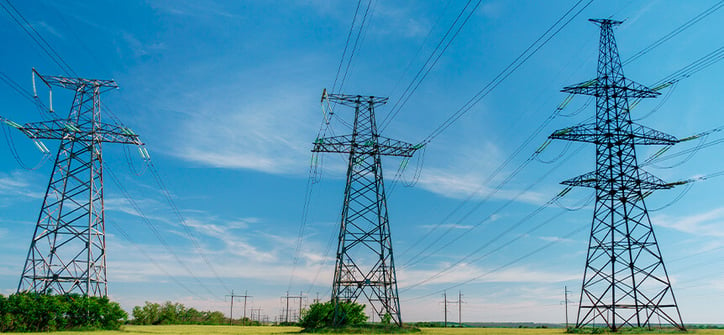
For high-voltage systems, such as those used to transmit electricity over long distances, kilovolts (kV) are used. One kilovolt is equal to 1,000 volts. Electricity transmission lines can operate at several hundred kilovolts in order to minimise energy losses during transmission.
Milivolts (mV) and Microvolts (µV)
In low-voltage applications, such as electronic and measuring devices, millivolts (mV) and microvolts (µV) are used. One millivolt is equal to one thousandth of a volt (1 mV = 0.001 V), while one microvolt is equal to one millionth of a volt (1 µV = 0.000001 V).
How electrical voltage is measured
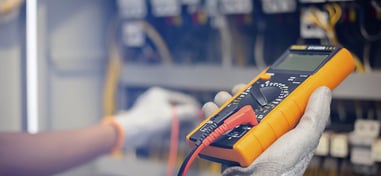
Devices known as voltmeters are used to measure electrical voltage. A voltmeter is connected in parallel with the component or section of the circuit whose voltage we want to measure. There are several types of voltmeters, ranging from traditional analogue models to digital ones.
- Analogue voltmeters: They use a needle that moves along a graduated scale to indicate the measured voltage. Although they are less common nowadays, they are still used in some applications because of their simplicity and their ability to display continuous changes in voltage.
- Digital voltmeters: These are the most commonly used today. These devices display the voltage reading on a digital screen, providing a more accurate measurement that is easier to read. In addition, many digital voltmeters can measure both direct current voltage (DC) and alternating current voltage (AC).
- Multimetres: A multimeter is a versatile tool that can measure not only voltage, but also current and resistance, among other electrical parameters. Multimeters can also be analogue or digital, although digital models are more common because of their accuracy and ease of use.
Applications of electrical voltage
Electrical voltage is used in almost every aspect of our daily lives and across a wide range of industries. Some of the most common applications include:
- Domestic electricity supply: In homes, the supplied electrical voltage is generally 230 volts in Europe and 120 volts in North America. This voltage is sufficient to power household appliances, lights and other devices. It is important to make sure that electrical appliances are designed to operate at the voltage used in the relevant region to prevent damage.
- Consumer electronics: Electronic devices such as mobile phones, laptops and televisions operate at much lower voltages than the domestic electricity supply. For example, mobile phones typically charge at voltages between 5 and 9 volts. Adapters and transformers convert the high supply voltage into the lower voltage required by these devices.
- Power transmission: High voltages, typically in the range of hundreds of kilovolts, are used to transmit electricity from power generation plants to end consumers. This helps reduce energy losses when transmitting electricity over long distances. Transformers located at different points in the electricity system convert these high voltages into lower levels suitable for domestic and industrial consumption.
- Safety and electrical voltage: Safety is the most important factor to consider before working with electrical voltage. High voltages can be dangerous and potentially fatal. It is essential to follow the established safety procedures, such as using personal protective equipment (PPE) and making sure that circuits are de-energised before working on them.
- Surge protection:Voltage surges, which are brief but significant increases in voltage, can damage electrical and electronic equipment. Surge protection devices, such as surge suppressors, are used to protect sensitive appliances from these variations.
Choose the optimal electrical power
At Holaluz, we not only supply 100% green energy, but we also aim to make your life easier and promote a fairer energy model. For this reason, we make all our technology available to you, whether you are already a customer or not, to help you calculate the electricity power level that best suits your needs.




 en
en
